Use a restaurant skills matrix to check role coverage
Three recorded closers are not three available options. Use a six-person example to check task evidence, support and overlapping work before assigning cover.
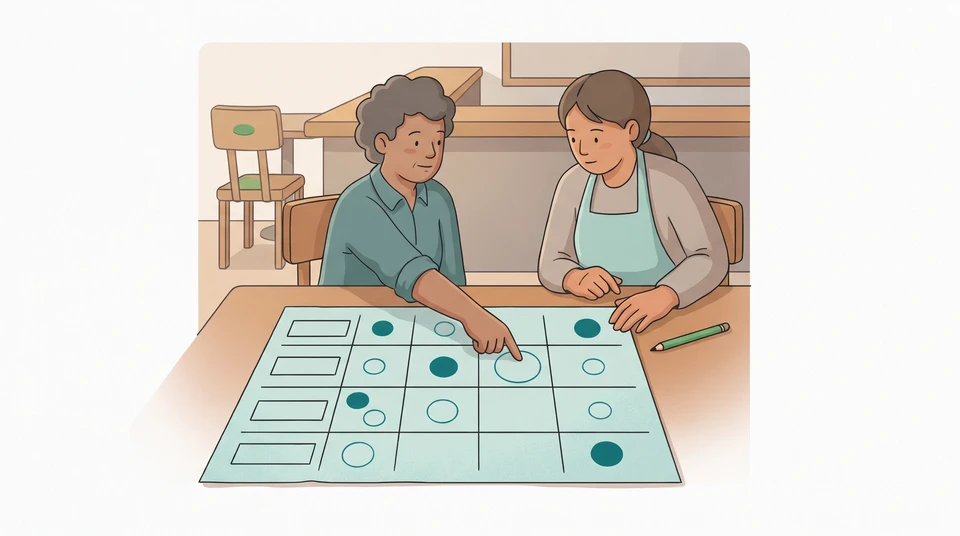
Put your team down one side of a sheet and the work you need covered across the top. For each person and role, record what a manager has observed, what support is still needed and where to find the dated note. Then check that view against one actual shift.
That last step matters. Three people recorded as ready to close do not give you three options for Friday if one leaves early, one is unavailable and the third is already covering the floor.
Start with paper or a spreadsheet you already use. You do not need another tool to make this check.
Choose stations and evidence-based readiness labels
Choose work that changes an assignment decision: till, floor service, dish area or a specific closing responsibility. Define the boundary beside each heading. “Close” might mean the floor-and-till closing sequence; it should not silently include kitchen shutdown, locking up and every other closing job.
For a cafe, coffee might need its own column. A bar might separate drink production from floor service. If the roles themselves are unclear, first map the restaurant positions and their handoffs.
Give everyone the same plain labels. Here is a small set to adapt:
- Ready (R): a manager has reviewed observed work for the stated task and conditions. Keep any limits in the note.
- Supported (S): the person needs named help for that work. Check that the helper can actually provide it.
- Not reviewed (?): you do not yet have enough relevant evidence to make the assignment. This is not a judgment that the person cannot learn it.
Do not use “ready” to mean “attended training” or “has done something similar elsewhere.” If the evidence is missing, ask the supervisor what they observed. Use a separate readiness assessment for the work you need to see, rather than filling a blank with a guess.
The US O*NET food-service supervisor profile includes both training workers and assigning workstations according to the work required. Use that connection when choosing your columns; it does not prescribe this matrix or its labels.
Build a small staff-by-role view
Imagine a six-person restaurant team preparing for Friday dinner. The manager uses four columns. Till means ordinary orders and payments; floor means the assigned dining section; dish means the venue’s dish-area routine. Close means the floor-and-till closing sequence only. Kitchen work, duty management, security and relief arrangements are checked separately.
In this example, the entries summarise manager-reviewed observations and support needs. R, S and ? use the meanings above—not a points scale or a ranking of employees.
| Team | Till | Floor | Dish | Close |
|---|---|---|---|---|
| Jo | R | R | ? | R |
| Ash | R | S | R | R |
| Bea | S | R | ? | R |
| Cam | R | S | S | S |
| Dev | ? | S | R | ? |
| Eli | S | R | S | ? |
Keep the short grid readable. Put the evidence underneath or link each entry to its note, rather than squeezing a paragraph into every cell. A blank sheet to copy needs these fields:
- Person and clearly defined role or task.
- Readiness label and any conditions or restrictions on the assignment.
- Observed work, date and observer’s name.
- Support needed, including who can provide it.
- Review owner, next check and review date.
For Bea’s Close entry, an example note might read:
Floor-and-till close: Jo observed Bea complete the current sequence without prompts on 21 October 2026. Kitchen shutdown and lock-up were outside the observation. Next check: Jo and Bea review the sequence on 5 November, or before assigning a changed closing routine.
Those are example dates, not a suggested refresher interval. Keep the note about the work. Do not add private reasons for availability or turn “not reviewed” into a permanent label about the person.
Check coverage against a real shift
Now put Friday’s hours and assignments beside the matrix. In this example, the manager needs till, floor and dish work covered from 9–10pm while the floor-and-till closing sequence starts at 9pm and runs to 11pm. The floor and closing work need separate people during that overlap.
The six-person team does not mean six people are available throughout:
- Jo leaves at 8pm and is unavailable afterward.
- Ash is unavailable Friday.
- Bea is available through 11pm, but already owns the floor until 10pm.
- Cam owns the till until 10pm and still needs support for closing.
- Dev owns dishes through 11pm; closing has not been reviewed.
- Eli can cover the floor independently but is available only from 10–11pm.
The Close column has three R entries: Jo, Ash and Bea. Jo and Ash cannot cover the required period. Bea can do the work, but counting Bea on both floor and close would hide a clash from 9–10pm. Eli’s 10pm arrival does not cover that earlier hour.
Cam’s S is not a fourth independent closer. If Bea must stay alongside Cam, Bea is not also free to run the floor. Nor does moving Dev solve the problem: dish work would lose its owner, and Dev’s closing readiness is still unknown.
Leave the 9–10pm closing gap visible. The manager can ask whether Eli could cover an earlier floor start, without treating that request as agreement. Until Eli confirms and the manager checks the changed shift arrangements, do not move Bea off the floor. If earlier cover is not possible, review the service and closing sequence with the leads; keep every necessary job assigned rather than simply crossing it out.
Once the coverage decision is settled, carry it into the roster draft. The matrix helps you choose among people; it does not replace checking hours, breaks, other duties or the employment requirements that apply to your venue.
Keep review dates and restrictions current
Name one manager to maintain the view. Before using an entry for an unfamiliar assignment, have that manager check the dated note with the relevant supervisor and team member. Ask whether the work, equipment, support or conditions have changed since the observation.
If Bea’s closing sequence changes, keep the earlier observation and add what needs checking before the new assignment. Do not quietly extend the old R to the new work. If someone needs practice, use a cross-training plan with real trainer time and cover; do not build the whole learning program inside the grid.
For Australian food-handling work, FSANZ advises recording who received training and when. It also directs businesses to check additional food-safety training requirements, including whether Standard 3.2.2A applies. Have the responsible manager check your venue’s requirements with the relevant regulator; an R in this sheet is not a certificate.
For US food-service requirements, use the FDA’s state agency directory to find a starting contact, then confirm the state and local requirements for your venue. Do not carry an Australian requirement into a US team record, or treat this example as a compliance checklist. Keep any required credential checks separate from the manager’s observation of the work.
You can keep the matrix and notes in your existing document. If you want learning records closer to shift planning, CrewCentral Training tracks role-based steps, progress and manager sign-offs beside scheduling. Hiring, onboarding, training and scheduling share team context. Your managers still decide readiness and check required certifications or licences; CrewCentral does not verify those for you.
For your next shift, choose the role with the fewest workable options. Check the evidence, the actual availability and the work each person would leave behind. Finish with a named assignment—or a visible gap and the manager who will resolve it.