Restaurant onboarding from accepted offer to the first independent shift
Give each new starter a clear arrival, supported practice and a manager’s decision about what they can cover before the next schedule.
Before your next starter arrives, name the manager who owns their welcome, the person helping them learn and the person deciding what they can cover without close supervision. Then connect those decisions to the schedule.
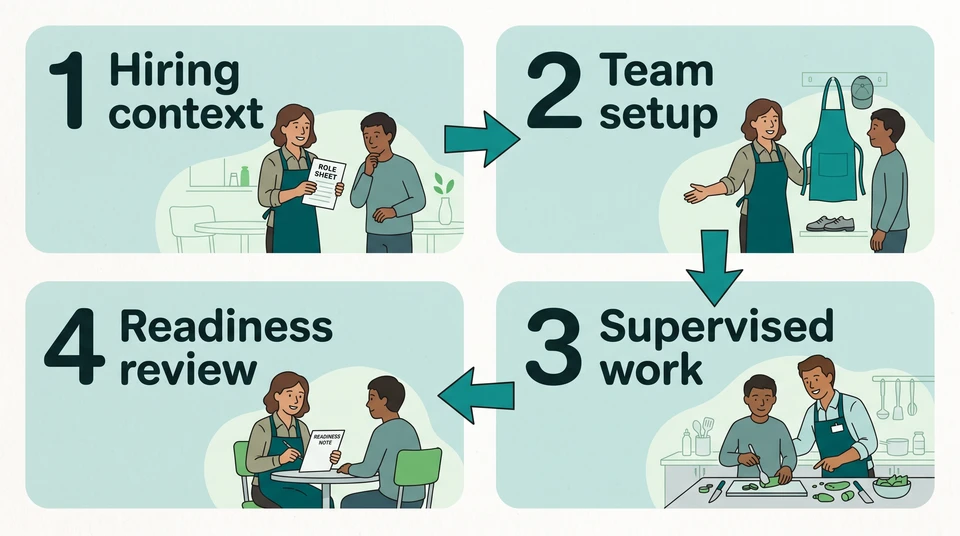
A useful restaurant onboarding process runs through four stages: hiring context, team setup, supervised work and a readiness review. New York City’s restaurant onboarding playbook starts at offer acceptance, not at the first clock-in. Use the stages below as a practical plan, not a deadline for becoming fully trained.
Imagine a small neighbourhood restaurant called Fern Table. Nora manages the floor. Jules has accepted a floor-runner role, and Dev is an experienced teammate who has agreed to be Jules’s buddy. Dev is also able to demonstrate the specific floor tasks Nora assigns; being a friendly buddy alone would not make someone the right trainer.
Nora keeps one short progress note for Jules. Each stage needs a named owner, something concrete to prepare or practise, and a next decision.
Carry over hiring context
The person who hired Jules gives Nora the agreed role, confirmed first-shift details, availability and any unanswered practical questions. Nora checks the details with Jules before building the first week around them. Availability tells her when Jules may be able to work; it is not agreement to every proposed shift.
Keep this note useful to the receiving manager. Leave interview opinions, identity documents and bank details out of it. Arrange private employment information through your appropriate secure process instead.
Nora’s starting note might read:
- Role: floor runner, beginning with supervised table clearing and resets.
- Arrival: meet Nora at the front entrance before the agreed lunch shift.
- Availability: the days and hours Jules has confirmed; proposed shifts still need agreement.
- Open question: who will explain where used service items go? Nora assigns Dev to demonstrate the venue’s process.
Send Jules the actual date, time, entrance, arrival contact and clothing or equipment instructions using the contact details they supplied. Ask for a reply confirming receipt. Agree any changed shift details separately. If no reply arrives, follow up through a supplied contact method and leave arrival unconfirmed rather than assuming silence means yes.
If hiring and first-shift management belong to different people, use the fuller accepted-hire handoff. If you do both jobs, skip the artificial transfer and keep the same essentials handy.
prepare team-specific setup
Nora owns preparation before Jules arrives. Dev agrees to be available for the welcome and knows which questions to bring back to Nora. If Dev is absent, Nora names a replacement and tells Jules who to ask for.
Prepare the things the role actually needs:
- A welcome and venue walk-through, including how to report a hazard or get help.
- Access to the instructions and equipment Jules will use, with someone available to explain them.
- A first-week plan naming the trainer, practice tasks and check-in owner.
- A place to record open questions and the next action, not just completed tasks.
Show Jules where the venue’s safety instructions are and who handles questions about them. Check any required role permissions, food-safety training or alcohol-service requirements with the relevant local authority; this plan does not replace them. Keep contracts, identity or work-authorisation checks, tax and pay setup with the appropriate people and systems.
For Australian teams, use Fair Work’s hiring guidance to check employment status, the applicable award or agreement and pay arrangements. US employers should check federal, state and local requirements for their venue. Do not copy another country’s paperwork checklist into your process unchanged.
In Fern Table’s example, Nora prepares the floor-reset instructions and confirms Dev’s time before adding practice to the schedule. She does not mark Jules ready because the welcome checklist is complete.
plan first-week supervised work
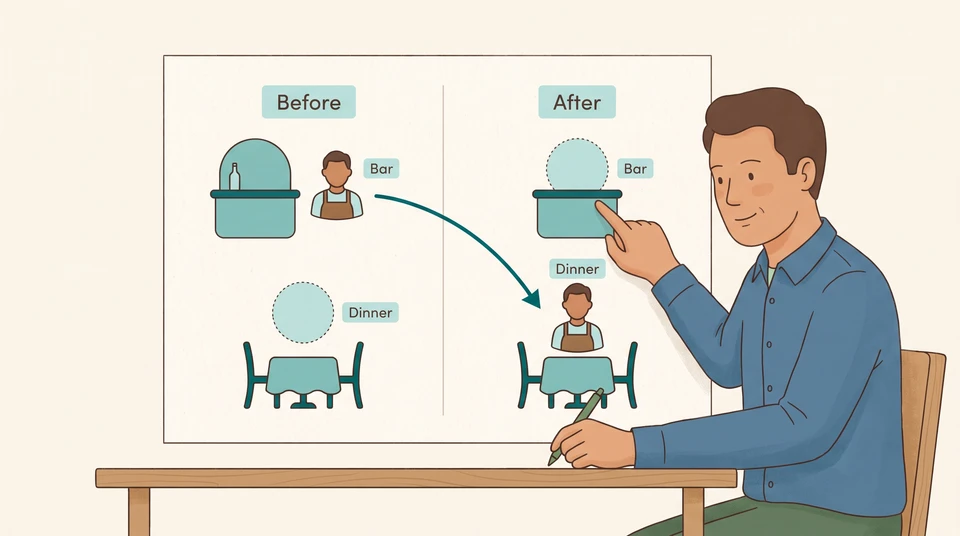
Choose a small set of tasks for the first week, then put real trainer time beside them. Tell the rest of the team who is covering service while the trainer demonstrates and watches practice. Do not count Jules as independent cover for work they are still learning.
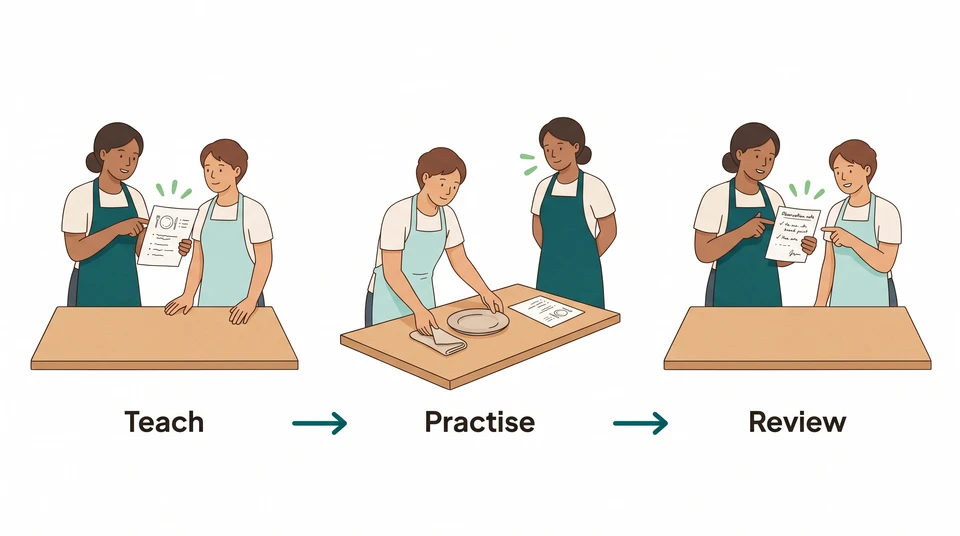
For Fern Table, Nora starts with clearing and resetting tables to the venue’s instructions. Dev demonstrates, Jules practises with Dev nearby, and Dev gives specific feedback. This follows the demonstration-and-observation approach in NYC’s training playbook, rather than asking Jules to learn by guessing during service.
Nora gives Dev a clear limit: if service needs Dev’s full attention, pause practice and tell Nora. Nora then arranges suitable support or changes the practice window. Jules should know who to call when unsure, not be left to finish an unfamiliar task alone.
At the end of each planned session, ask Jules what remains unclear. Dev records the task, what Jules did without prompting and what still needed help. Nora chooses the next practice step. If the instructions are not clear, demonstrate again or use a diagram rather than treating a nod as understanding.
Plan training as paid working time and have the person responsible for pay check the arrangements. In Australia, Fair Work says employees doing training as part of their job must be paid for those hours. In the US, whether training counts as hours worked depends on the circumstances; use the Department of Labor’s training-time guidance and applicable state rules before treating any session as unpaid. Moving required preparation online does not make it free homework.
A first-week plan is a starting point, not a promise of independence by the end of the week. Keep the tasks and supervision matched to the person and work. Safe Work Australia’s training guidance also stresses individual needs, practice, feedback and ongoing supervision.
review readiness for independent coverage
Before the next schedule is confirmed, Nora reviews Dev’s notes with Jules and watches the work under the conditions she expects Jules to handle. Ask three practical questions:
- Which tasks can Jules complete to the venue’s standard without close prompting?
- What still needs supervision, and who will provide it?
- What should Jules stop and refer to the shift manager?
Record a bounded decision, not a single “trained” tick. For example: “Nora reviewed routine table resets during lunch. Jules can take that assignment with the shift manager available for questions. Order taking and closing remain supervised; review those separately after practice.” Only write that decision after the observation supports it.
Here, an independent shift means working within the reviewed role without a buddy beside every task. It does not mean working alone, supervising other people or being ready for every station. Nora checks the actual shift’s duties, availability and required support before assigning it. If the evidence is not there yet, she keeps supervision in place and names the next practice session.
Ask Jules what help they still need. Revisit the decision when the duties or service conditions change. Adding a second role later is a separate cross-training plan, not an automatic extension of this onboarding review. If the schedule still lacks ready cover, check the staffing gap rather than relabelling a learner.
Start with a note and a conversation; no new software is needed. To lay out the first week, try the free schedule maker. It is a manual, browser-local editor you can use without an account or email, not a shared onboarding record or an AI schedule generator. Confirm readiness and availability with your team yourself.
When you want worker details, team-specific checklists and onboarding progress together, see CrewCentral onboarding. Hiring, onboarding, training and scheduling share the same team context. Contracts, payroll and background checks stay separate; any AI-assisted schedule drafts still need manager review.
For your next starter, fill in four names or responsibilities today: who confirms the hiring context, who prepares arrival, who supervises practice and who reviews readiness. One person may own several steps. What matters is that the next shift does not depend on everyone assuming someone else handled them.