Staffing versus scheduling for a small restaurant
Start with the work, the time and who is ready. Then decide whether to change an assignment or address a genuine coverage gap.
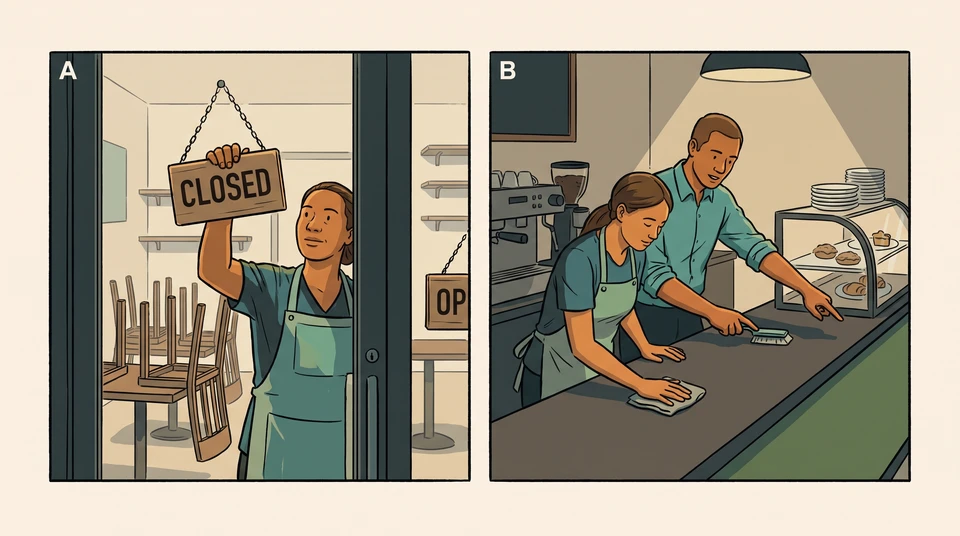
Before moving names around Friday’s schedule, write down the uncovered job and its hours. Then ask: do we have someone who is ready, available and able to do it without leaving another job uncovered?
That question helps you choose between changing an assignment and addressing a gap in your team. Start with the work, not the headcount.
Distinguish workforce capacity from assignments
For this check, staffing means the people and skills you can draw on. Scheduling means deciding who does which job at which time. The two fit together: Sling’s staffing and scheduling guide also discusses skills, availability and shift assignments.
A name in a closing slot isn’t enough. Ask the shift lead who can complete the required closing tasks independently. Ask those people whether they can work the exact hours. Include the closing work, not just the end of customer service.
Keep a learner’s supervised shift separate from independent cover. Hiring, onboarding and training belong in this decision too: if you recruit someone for closing, plan their welcome and role training before counting them as ready to close alone.
map service roles
Take the next service you’re planning. Write a short coverage note for each job you need covered:
- Name the task and time window, including preparation and closing.
- Ask the shift lead what someone needs to do independently.
- List the people who are ready, then confirm their availability for those hours.
- Check whether each person is already needed for another task at the same time.
For example, ask: “Can you cover Friday closing from 9 to 10 pm, including the closing checklist?” Record the answer before changing the assignment. A reply confirming they’ve read your message isn’t confirmation that they can work.
Friday A: missing availability
For example, imagine Friday at Harbor Table restaurant. Manager Maya has set a requirement for one independent closer from 9 to 10 pm. This is an example requirement, not a staffing recommendation for your venue.
Jordan can complete those tasks independently. Maya confirms Jordan is available for that hour, is permitted to work it and isn’t needed elsewhere. That availability was missing from Maya’s planning notes, so she had left the closing role unassigned.
Before the change, the example has one required closer and none assigned: one uncovered role. Assigning Jordan leaves no gap in that single role. Maya checks the rest of the affected schedule before accepting the change. If moving Jordan leaves the floor uncovered, she has moved the problem, not solved it.
Friday B: no ready closer
Now suppose Harbor Table has the same one-closer requirement for 9 to 10 pm, but no one in the available pool is ready to close independently. A learner is available but still needs supervision.
The example starts with one uncovered role. Rearranging this pool still leaves one uncovered role because it contains no ready, available independent closer. Putting the learner’s name in the cell doesn’t change that assumption.
Maya must now find appropriate ready cover or review what service the venue can safely offer. She can also plan supervised learning for a later service or investigate hiring for the missing role and hours. Neither option creates independent cover for this Friday by itself.
diagnose persistent vs one-week gaps
Compare the gap with similar services, not every shift on the calendar. Check the task requirement, confirmed availability and overlapping assignments each time. Note what changed: bookings, the service offered or the people available.
Don’t use “it keeps happening” as an automatic hiring rule. Repeated gaps may still come from incomplete availability or an assignment conflict. Equally, a one-off Friday may have a genuine shortage of ready people. Test whether an assignment works before choosing a longer-term response.
Before changing hours, check the employment rules that apply to your team. In Australia, awards and agreements can add roster-change rules; Fair Work’s roster guidance explains the general requirements. In the US, include closing and training when checking work time against federal hours-worked guidance and applicable state or local rules. Don’t treat extra closing or training as free capacity.
decide the next hiring/training/roster action
Choose the next action from the constraint you’ve found:
- Missing information: the manager confirms the exact availability, updates planning notes and checks assignments again.
- Ready people assigned elsewhere: the manager tests a move across all affected jobs and times. Reject it if another gap appears.
- Skills still developing: the shift lead plans supervised practice and reassesses readiness. Keep appropriate independent cover for the current service.
- No workable cover after those checks: the owner identifies the missing role and hours before considering hiring or a reviewed change to service. Plan onboarding and training for any new starter.
To lay out the assignments, try CrewCentral’s free schedule maker. It’s a manual, browser-local editor you can use without an account or email. You can inspect employee and position views and open shift details. Confirm availability and readiness with your team yourself; the editor doesn’t make those judgments.
For your next service, write one sentence: “The uncovered job is ___, from ___ to ___, and the next action belongs to ___.” Use that note to decide whether to change the roster, develop a skill or investigate hiring—not just fill an empty cell.