Turn a restaurant procedure into a teach practise review sequence
Choose one venue instruction, separate demonstration from practice and record the learner’s next step without mistaking a tick for readiness.
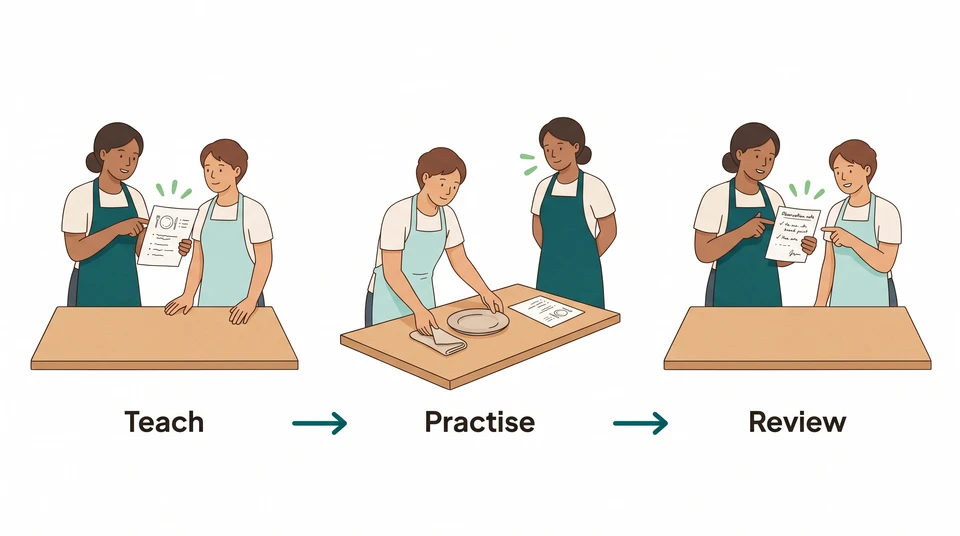
A procedure tells your team what to do. To turn it into a learning session, give the coach a task to demonstrate, the learner a chance to try it and the supervisor something specific to review.
Start small. Choose one part of a shift, not an entire role. For example, use your venue’s table-presentation instruction to plan a coached practice session. Keep the table’s cleaning and hygiene preparation under your separate procedure; this session is about presentation, not how to clean a table.
Choose one observable procedure
Pick an instruction your venue already uses and check that it is the current version. Ask the learner to show you the result you want to observe. “Arrange this table to match our approved layout” is more useful than “understand table service”.
Before you book practice, check the basics:
- Which instruction will the coach and learner use?
- Are the required items available?
- Can the coach stay to watch the learner’s attempt?
- Can the learner access and understand the instruction?
If two supervisors teach different layouts, settle the instruction first. If supplies are missing, restore them or choose another agreed task. Don’t make the learner repeat a lesson to fix a supply problem.
Separate explanation from practice
Give the coach two separate jobs: show the task, then watch the learner try it.
First, explain what the finished result should look like and why the venue uses that instruction. Demonstrate it with the instruction available. Ask the learner to explain the task back or point out anything unclear before they begin.
Next, let the learner attempt the task while the coach observes. Leave room for questions and give feedback about what actually happened. Australia’s hospitality unit Coach others in job skills includes demonstration, checks of understanding, practice, constructive feedback and follow-up.
Imagine a cafe manager, Maya, coaching a new starter, Sam. The table has already been prepared under the cafe’s hygiene procedure. Maya selects the cafe’s current presentation instruction and demonstrates the finished layout. Sam then arranges a table using that same instruction while Maya watches.
If service pulls Maya away, she moves the observation to a time she can watch or asks an available, suitable coach to take it. She does not record an attempt she missed as one she observed.
Define evidence a supervisor can observe
Before practice, write down what the coach will compare with the instruction. Keep it specific: the finished presentation, anything left unfinished and the help needed along the way.
For Maya and Sam’s session, the observation might be:
Sam compared the table with the current layout instruction. Maya prompted Sam to check it again before finishing. Sam spotted a mismatch and corrected it after that prompt.
That note separates the result from the support. “Completed training” would leave the next supervisor guessing whether Sam worked independently or needed help.
Ask the coach to record:
- What did the learner do without help?
- Where did they need a prompt or another demonstration?
- What still needs practice or clarification?
Use those observations to choose the next learning step. Reading the procedure or completing a coached attempt is not the same decision as being ready to cover a busy service alone. Keep this session focused on the selected task; don’t turn its completion into sign-off for an entire role.
Record review and the next learning step
Use a paper note or your team’s existing approved record. You don’t need a new system to begin. Record the instruction and version, learner, coach, observed attempt, help given and feedback. Finish with a named reviewer and a clear next action.
For the cafe example, Maya’s note could read:
| Record | Example entry |
|---|---|
| Procedure | Current cafe table-presentation instruction; note its version or date |
| Learner and coach | Sam; Maya |
| Observation | Corrected a mismatch after a prompt to compare the table with the instruction |
| Feedback | Compare the finished table with the instruction before calling it complete |
| Next practice | Another presentation attempt, with the instruction available |
| Next review | Maya to observe before the next opening shift; note whether a prompt is needed |
If the instruction changes before that review, check the changes with Sam before relying on the earlier observation. If the next attempt still needs support, record what happened and choose the next practice action rather than ticking it off because time has passed.
Keep this short record with the information the next coach needs. As hiring moves into onboarding, role training and scheduling, make the next learning action clear to the manager planning the person’s work. Don’t leave them to infer readiness from attendance alone.
To explore CrewCentral’s approach to role learning and manager review, see CrewCentral training. For today’s session, start with one current instruction, one observed attempt and one agreed next step.