Choose a prep cook and line cook role split
Two kitchens can have the same cook headcount and need different role splits. Compare preparation, live orders and the work that cannot wait.
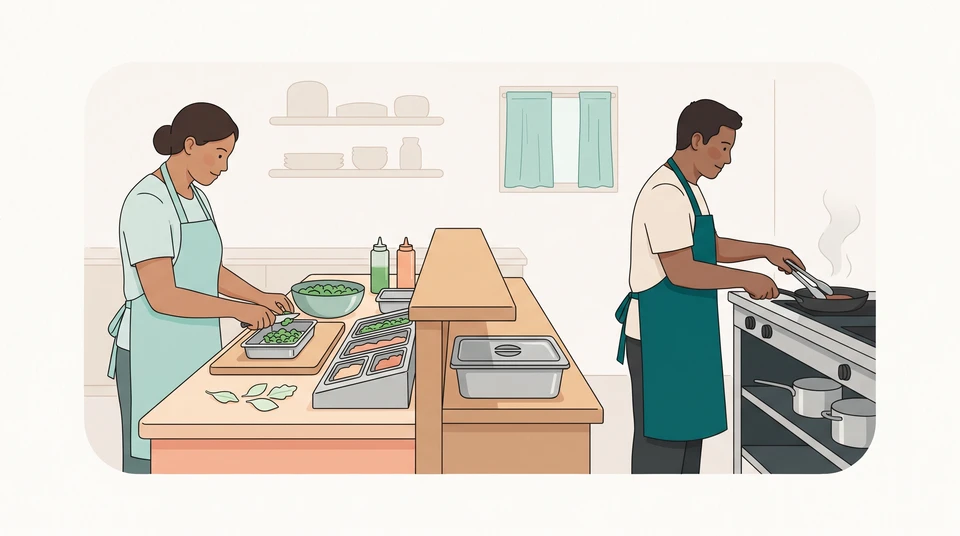
Before advertising for another cook, find out which work is waiting: ingredients for service, dishes ordered by guests, or both at once. That is the useful starting point for the prep cook vs line cook decision—not which title sounds more senior.
Use prep cook here for work organized around getting ingredients and batches ready. Use line cook for work organized around a service station and incoming orders. One person may do both at different times. The question is whether your kitchen needs those jobs done at the same time.
Compare the work rather than job-title prestige
Start with the tasks, not a rank. US O*NET’s food-preparation profile includes measuring ingredients, preparing vegetables and supplying cooks. Its restaurant-cook profile covers cooking, plating and ingredient preparation—and lists both line cook and prep cook among reported titles. The labels alone do not tell you what someone can cover.
For Australian venues, the ABS describes cooks preparing and cooking food and kitchenhands assisting with preparation and replenishment. Do not translate either US title into an Australian employment classification from the name alone. Describe the actual work and check the arrangements that apply before making an offer.
For your kitchen, write two short lists:
- Prep work: which ingredients or batches need preparing, the required quantities, the ready-by point, storage instructions and who checks the result.
- Line work: the station, dishes it handles, how orders arrive, who coordinates timing and who can take over if the cook must step away.
Give cleaning, dishwashing, deliveries and closing their own owners too. They do not disappear because you have split the cooking roles. Use your venue’s food-safety procedures for the work itself; this comparison is not a preparation or storage instruction.
Map prep and live-service bottlenecks
Ask the kitchen lead to follow one ordinary service from preparation through close. Note each time a required job waits, what the assigned person is doing instead, and what happens next.
Keep the note specific: “The grill cook left live orders to portion the next tray,” rather than “prep was slow.” Check whether the tray was late because preparation started too late, the planned quantity was wrong, supplies were missing or replenishment genuinely had to happen during service.
Use this small decision sheet:
| What you observe | What to check before changing the role |
|---|---|
| Prep is unfinished when orders start | Could the work fit earlier, with supplies, space and paid working time available? |
| The line repeatedly stops for replenishment | Which replenishment tasks must happen during orders, and who could own them then? |
| Ingredients are ready but orders still wait | Is the constraint cooking equipment, station workload or coordination rather than prep cover? |
| A combined cook role works only while the manager helps | What work does that manager leave, and is their help actually available each service? |
If the problem affects several roles or times of day, use the broader understaffing diagnosis. Keep this decision focused on the prep and live-cooking work you need covered together.
Test combined and separate role arrangements
Imagine two small kitchens, each with two cooks during the service window. Their menus and preparation needs differ. The examples below compare duties, not recommended staffing levels. Floor service, dishwashing, breaks and closing still need a separate coverage check.
Kitchen A: preparation can finish before orders start
At Cedar Cafe, Alex prepares the planned vegetables and portions before lunch, then takes one service station. Jo sets up and runs the other station. Both cooks are ready for their assigned service work.
For this combined arrangement to be workable, the manager must check that Alex’s prep fits within scheduled working time, the prepared quantities suit the planned service, and replenishment will not repeatedly pull Alex away from orders. Jo is not spare cover while running another station.
If those checks hold, Cedar can describe Alex’s job as prep followed by line work. A separate prep-only position is not the automatic answer. If prep is regularly unfinished, the manager should revisit its timing and workload rather than expect Alex to finish it while serving the same orders.
Kitchen B: replenishment competes with live cooking
At Harbour Kitchen, the menu uses one hot cooking station, but planned ingredient replenishment continues during dinner. Alex owns that prep and replenishment; Jo owns the hot station. Neither is silently covering the other’s work.
This split is only a candidate plan. The manager must first establish that Jo can handle the actual hot-station workload and that Alex’s prep duties leave time for the replenishment needed. If Jo also needs a second service cook, allocating Alex to prep does not solve both gaps. Arrange suitable additional cover or change the service plan before relying on the split.
With the same cook headcount, Cedar is testing sequential duties; Harbour is testing simultaneous duties. Copying either arrangement without checking the menu, workload and interruptions would miss the point.
Give the test a stop condition
Choose a comparable service and tell both cooks what you are testing. Record the prep ready-by point, the station owner, the replenishment owner and who can change the plan.
Ask the kitchen lead to stop the test if required prep is unfinished, a station is left without ready cover, or food-safety procedures cannot be followed. Agree a workable fallback before service—not an assumption that the manager can cook while doing another job.
Afterward, review what waited, which duties collided and whether necessary work moved into the close. Keep the arrangement provisional if the service was unusually quiet or needed unplanned help.
Decide what to advertise and what to cross-train
Turn the decision into a short role brief. Name the main work, when it happens, who provides support and what still needs training.
For Cedar, the brief might say:
Prepare the agreed lunch ingredients before service, then run the assigned station during lunch. The kitchen lead checks readiness before orders begin. Tell the lead if preparation will run into service; support must be arranged rather than leaving the station unattended.
For Harbour, it might say:
Own the agreed prep and ingredient replenishment during dinner while the line cook runs the hot station. Follow the venue’s preparation and storage procedures. Raise a shortage with the kitchen lead before changing quantities or taking on another station.
Add the actual hours and any applicable requirements before advertising. Avoid “help everywhere” if the job depends on being available for a particular task at a particular time.
For cross-training, choose one useful next skill and name a supervisor. A prep cook learning a service station is not independent line cover yet. Protect the practice time and the person’s usual duties; use a separate cross-training plan for the learning sequence.
Start with a page of notes. If you want to sketch the agreed shifts, the free schedule maker lets you edit a browser-local plan without an account or email. It is manual—not AI generation or shared cloud storage.
When you are ready to organize candidates around the role, CrewCentral Hiring keeps candidate details with open roles; your team makes the hiring decisions. Hiring, onboarding, training and scheduling share team context, so carry the agreed duties into the starter’s first shift and training plan. Keep the manager’s readiness check before assigning independent cover.