Diagnose understaffing before you rewrite the restaurant roster
People can be on shift while one essential role is uncovered. Track the work that slips, test one practical change and review whether the gap remains.
Before you add another shift, write down the job that is getting missed, when it happens and who can do it. That gives you something more useful to investigate than “we need more people”.
If tonight’s service is already stretched, deal with the immediate gap first. For a problem that keeps returning, use the next planning session to separate four possibilities: the right person is there at the wrong time, tasks clash, someone needs training, or you really need more role-ready cover.
Record where service breaks down
Ask the shift manager to keep a short note during the problem period. Use work records you already have, such as order times, the roster and the closing checklist. Then ask the team what got in the way.
Record:
- The time and task: “9.15 pm — closing checks not started”, rather than “bad close”.
- The service effect: which order, customer request or necessary task waited?
- The work happening alongside it: who was serving, washing up or handling another job?
- The conditions: bookings, a walk-in group, missing supplies or equipment trouble.
- The person able to take responsibility for that task, and whether they were available then.
Keep the notes about work, not private explanations for someone’s availability. You need to know whether they can cover the period, not their medical or family circumstances.
Compare similar services, not just a quiet Tuesday with a busy Friday. Look for the same task slipping at the same point. A late order on one evening is a reason to investigate, not proof that the venue needs another employee.
Australia’s hospitality service training standard covers preparation, service and end-of-shift duties, including team debriefs. Use that whole-service view when you review what happened on the shift, rather than stopping your notes when dinner orders slow down.
Check the role in each hour, not just the day’s headcount
Imagine a neighbourhood restaurant where enough people work across the day to fill its usual planned shifts. Dinner service runs until 10 pm, and some closing work starts while the last tables are still being served.
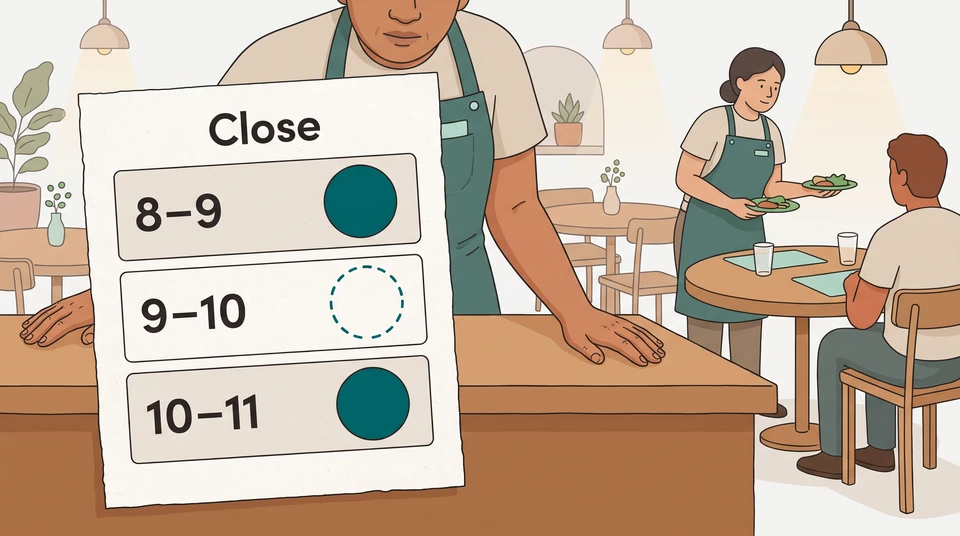
The manager’s notes show a recurring gap. Ben can lead the close, but his shift ends at 9 pm. Jo, the next manager trained for that responsibility, starts at 10 pm. Other team members are present between them, but none is ready to lead the closing checks independently.
Read the evening by task:
- 8–9 pm: Ben oversees closing preparation alongside service. The manager checks which duties he can realistically combine.
- 9–10 pm: the floor team continues serving. Closing checks have no role-ready owner; unfinished work is left for Jo.
- 10–11 pm: Jo takes responsibility for the close, including work carried over from the previous hour.
The gap is the closing responsibility from 9 to 10 pm, not an empty restaurant. Counting everyone who worked that day would miss it.
Australia’s roster training standard calls for a complementary mix of skills and consultation with colleagues. For this example, that means checking who can lead the close and when—not assuming every person on the roster can cover every task.
Separate timing, task design, training and headcount
Take the notes to the people who worked the shift. Ask which explanation fits, and what evidence would change your mind.
- Timing: is a role-ready person scheduled earlier or later than the gap? Check their actual availability before considering a shift change.
- Task design: is the same person expected to serve customers and complete a separate closing job at once? Identify a task that can genuinely move, and check who will own the work left behind.
- Training: is someone available but not ready to do the task independently? Name the skill to practise and the person who can supervise. Keep experienced cover in place while they learn.
- Headcount: after checking timing and tasks, is there still necessary work without enough available, role-ready people? Write down the specific role and period before deciding what additional cover to seek.
Also check the competing explanation. If the dishwasher stopped working or an unusual group arrived, another person on the roster may not address the underlying problem. If the same role gap recurs under ordinary conditions, take that evidence seriously too. Don’t turn “diagnose first” into a reason to leave the team stretched indefinitely.
Test one bounded fix without moving the gap elsewhere
In the restaurant example, the manager could ask whether Jo is available to start earlier on the next comparable service. Before making that change, check the rest of Jo’s schedule, the applicable employment requirements and whether the later close would still have cover.
For Australian venues, start with Fair Work’s roster guidance and the award or agreement that applies to your team. US managers should check the requirements that apply to their own location and employment arrangements; the Australian guidance is not a US rule.
If an earlier start is workable, test that one change on a named service and set the review for the following day. Keep the floor assignment and closing responsibilities clear. Don’t count Jo as available for two incompatible jobs at once.
Before the test, agree on three checks: did closing work start when needed, did customer-facing work still get covered, and did the later close remain workable? Record what actually happened. An earlier start is a proposed fix here, not a promised result.
If no suitable person is available, don’t assign an unready team member just to fill the square. Arrange experienced support or reduce the work you take on to what the team can responsibly cover. If safe service is in doubt, stop the test and address that risk first.
Review whether the gap persists
The next day, review the notes with the shift lead and the people affected. Was the original task covered? Did another task slip instead? Was demand comparable, or was the test unusually quiet?
Keep a useful change provisional until you have checked it again. If the role gap remains, decide whether the next action is supervised training, a different task arrangement or additional role-ready cover. A hiring brief can then name the work and availability you need: for example, leading the close during late dinner service. Don’t assume a new starter can take that responsibility before onboarding and training.
US owners can use the same observation exercise: O*NET’s food service manager profile includes scheduling hours, assigning duties and resolving service complaints. Keep the review focused on the work your own venue needs covered.
Put the finding into your next draft
Start with paper or your existing roster. If you want a free place to sketch the revised week, try the CrewCentral schedule maker. You edit it manually in your browser, without an account or email to start. It is browser-local, not a shared cloud roster or an AI generator; it won’t diagnose understaffing for you.
When you need a team workspace, CrewCentral Scheduling brings roles, availability and roster review alongside hiring, onboarding and training. Account-based AI can prepare a draft, but the manager reviews and adjusts it before publishing. You still decide whether someone is ready for the work.
Take one finding into the next roster: the task, the uncovered period, the proposed change and when you’ll review it. That is the decision to make before rewriting the whole week.