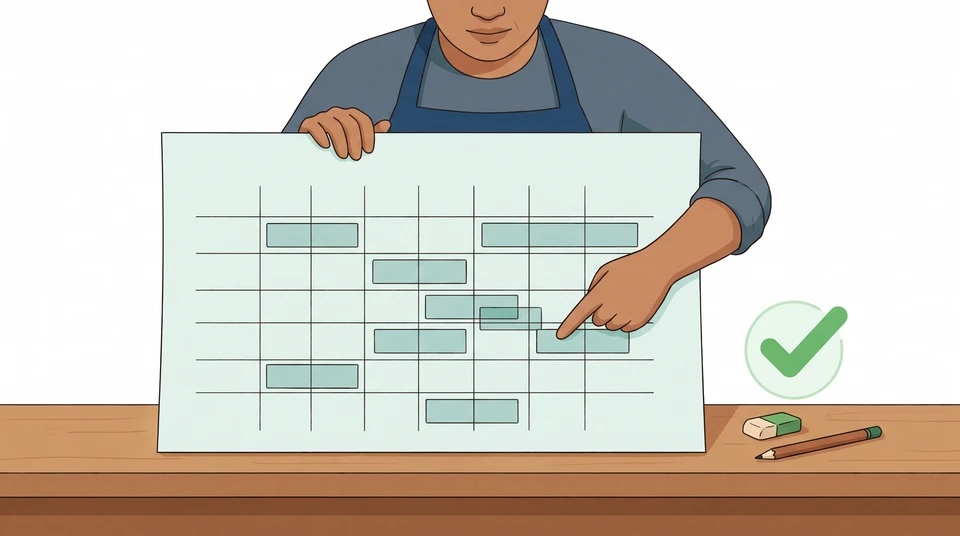
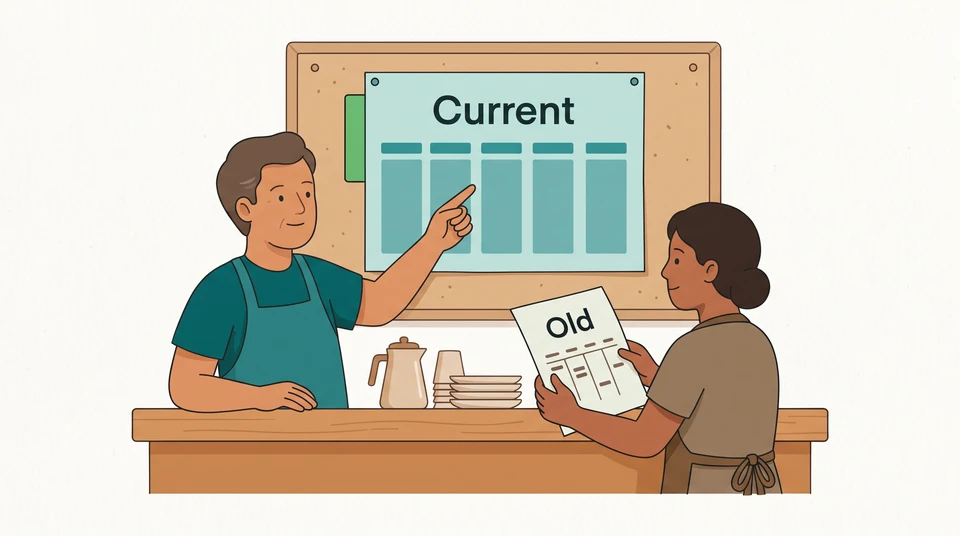
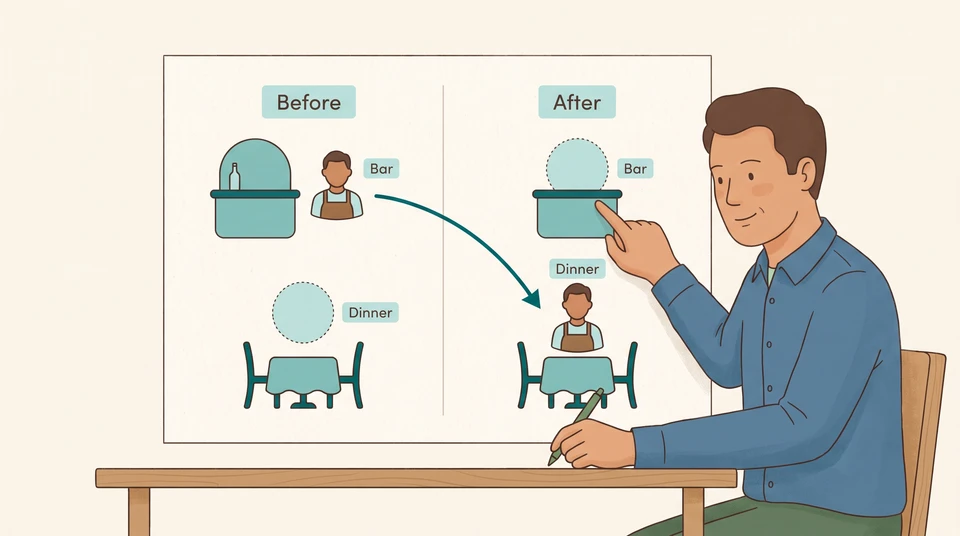
Reduce wasted roster hours without leaving service gaps
Could one dinner start move thirty minutes later? Follow the preparation, protect service backup and review what happens before repeating the change.
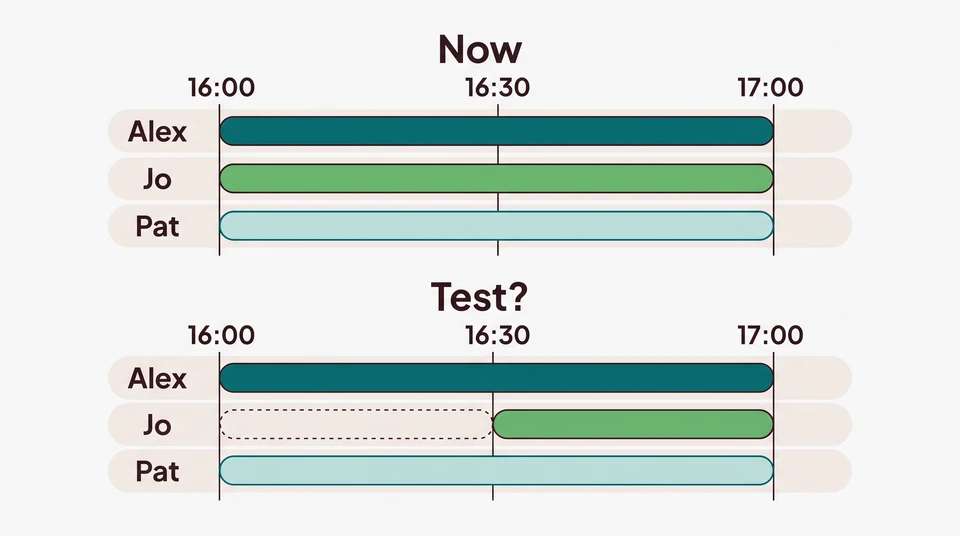
Before shortening a quiet-looking overlap, ask what the team is getting ready for. The gap between lunch and dinner may be when people reset tables, restock, take breaks or help a new starter. Keep the overlap if that work needs it.
Start with one question: could a specific piece of preparation move later without leaving service, relief or dinner readiness uncovered? Write down the current work, compare one proposed change and decide what would make you keep or reverse it.
Observe work by time and role
Choose comparable services: similar bookings, menu, opening hours and team experience. Ask the shift lead to note what happens between the lunch rush and dinner setup. Include a service when lunch runs late, not just the easiest afternoon.
For each job, record who does it, when it starts and finishes, what interrupts it and when it must be ready. Add guest requests, cleaning, stock, equipment checks, breaks and supervision. A quiet dining room is not a complete work list: the US O*NET server task profile includes clearing, cleaning, setting tables and stocking service areas alongside serving guests.
Then talk to the people doing those jobs. Ask, “What would wait if this person started later?” Follow that work through to dinner and closing. If preparation returns as a late finish, the shorter afternoon did not remove it.
A lunch-to-dinner example
Imagine a small restaurant serving late lunch guests through the afternoon, with dinner bookings from 5:30 pm. Alex covers the lunch floor; Jo takes the dinner floor. Pat, the shift lead, is already present throughout the 4–5 pm comparison window, responsible for oversight and available service backup. Kitchen and dish-support assignments stay unchanged.
Suppose the manager’s planning notes identify these conditions:
- Alex can cover the expected remaining guest work until 5 pm, with Pat available for an interruption. Neither has another simultaneous assignment that removes that cover.
- Main cleaning and table reset are complete before 4 pm. Jo’s remaining preparation is ten minutes folding cutlery, ten minutes restocking the service station and five minutes checking the dinner room. Supplies are ready; none of these jobs needs two people.
- Jo and Alex need five uninterrupted minutes for their handover. Pat covers guest requests during that handover and does no separate job then.
- The existing break and relief plan does not use Jo before 4:30 pm. Every affected person’s breaks, later relief and closing work still have cover; no trainer or learner depends on the removed interval.
These are example assumptions to check against your own services, not preparation times or staffing levels to copy. If any condition fails, keep the earlier coverage.
Distinguish necessary coverage from idle overlap
Separate work that must happen now from work that can genuinely wait. A dinner-room check may fit later; a guest payment, a required relief period or a task needing two people cannot simply disappear.
In the example, compare the work before changing the shift:
Current plan: Jo starts at 4 pm
- 4–4:10: Jo folds cutlery. Alex owns guest service; Pat keeps oversight and backup.
- 4:10–4:20: Jo restocks the service station. Alex and Pat keep the same responsibilities.
- 4:20–4:25: Jo checks the dinner room.
- 4:25–4:55: Jo is additional floor backup. Pat also remains available; check whether both backups are actually needed.
- 4:55–5: Alex hands over to Jo. Pat covers the floor during those five minutes.
Conditional plan: Jo starts at 4:30 pm
- 4–4:30: Jo is not working. Alex owns guest service; Pat retains the existing oversight and backup role. Jo’s preparation waits—it is not reassigned to Alex or done before Jo’s start.
- 4:30–4:40: Jo folds cutlery.
- 4:40–4:50: Jo restocks the service station.
- 4:50–4:55: Jo checks the dinner room. Alex still owns guest service; Pat remains available.
- 4:55–5: The same handover happens, with Pat covering the floor. From 5 pm, Jo takes guest service and any early arrivals; Alex’s shift ends. Pat checks dinner readiness with Jo before bookings begin, while the unchanged kitchen and dish team complete their own work.
The proposal moves Jo’s preparation thirty minutes later and removes Jo’s extra backup window. It does not create spare capacity. Pat must still be able to help Alex while Jo prepares. If Pat is handling a delivery, supervising someone or covering another role, stop and rebuild the plan with enough people.
Compare rostered hours, not promised savings
Alex’s example shift stays noon–5 pm: five hours. Jo’s current shift is 4–10 pm: six hours; the proposed shift is 4:30–10 pm: five and a half hours. Closing responsibilities and the 10 pm end stay unchanged.
For those two floor shifts, the rostered spans total 11 planned person-hours before and 10.5 in the proposal. The difference is 0.5 person-hours: one person’s thirty-minute start change. In the 4–5 pm window alone, Alex and Jo contribute two planned person-hours before and one and a half after. Pat’s unchanged presence is additional and is not included in either floor total.
Those figures sum scheduled start-to-end spans without deducting breaks. They are not hands-on task time, paid or payable hours, a whole-venue total or a wage saving. Check the applicable employment arrangements and actual pay implications separately before changing a shift. Do not turn a shorter roster into an assumption that less pay is owed.
Test one bounded change
Choose one comparable service, not the whole week. Before confirming it, the manager checks Jo’s availability, discusses the proposed start with the affected team and checks the employment requirements that apply to the venue and worker. Leave the shift unchanged while any requirement or coverage question is unresolved.
Write a short trial note: the service date, Jo’s proposed start, who owns each job above, what must be ready and who can stop the test. Keep all required work within scheduled working time; Jo is not expected to prepare or answer work requests before starting.
Check the awkward combinations before you commit:
- Late lunch and an early arrival: can Alex serve both, or can Pat take one without leaving another duty? If both people are already occupied, retain Jo’s earlier start.
- Equipment or supply delay: would Jo’s later restocking run into handover? Keep more preparation time if the task no longer fits; do not skip checks to protect the shorter shift.
- Relief or training: does someone need Pat during this window? Preserve that support and the break plan rather than treating Pat as two people.
- Dinner and closing: can Jo finish preparation, take the handover and serve early guests without pushing necessary work into the close?
Pat checks conditions again before the changed window. If lunch is running late or preparation is behind, Pat stops the trial and arranges real available support or changes the service plan. Jo is not assumed to be available before 4:30. An already-started trial may need a different recovery from simply restoring the old shift on paper.
Review service impact before repeating
After the service, Pat and the team compare the trial with the earlier notes. Record actual preparation finish times, interruptions, guest work that waited, whether handover happened, dinner readiness, relief coverage and any work carried into closing. Note whether demand was genuinely comparable.
Keep the change provisional only if the work fitted, support remained available and service was ready without rushed checks, missed relief or a later finish. If the trial was unusually quiet, gather another comparable service before drawing a conclusion. If work slipped or backup was needed but unavailable, restore the earlier start for the next suitable service and revisit the task plan.
A lower roster total is not the success measure. The decision is whether your team can complete the same necessary work with the proposed timing.
Sketch the comparison on paper or in CrewCentral’s free Schedule Maker. It is manual and browser-local, with no account or email needed to start. You can edit, print or export CSV; it does not generate an AI roster, calculate this trial’s savings or provide shared cloud storage.
For a connected team workspace, CrewCentral Scheduling brings availability, role skills and roster drafts alongside hiring, onboarding and training. Account-based AI can help prepare a draft; a manager reviews and adjusts it before publishing. You still decide whether the work fits.
Take one overlap into your next planning conversation. Name what might move, who would own it and what would make you keep the current cover.