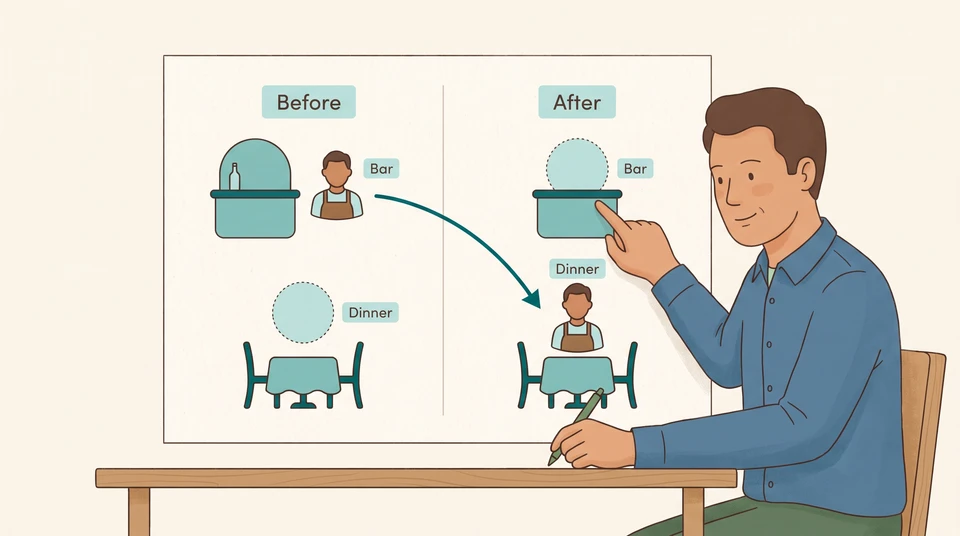
Scheduling one employee across two hospitality venues
A 2 p.m. café finish cannot cover a 2 p.m. bar start. Check the journey, agree coverage and give both managers one confirmed plan.
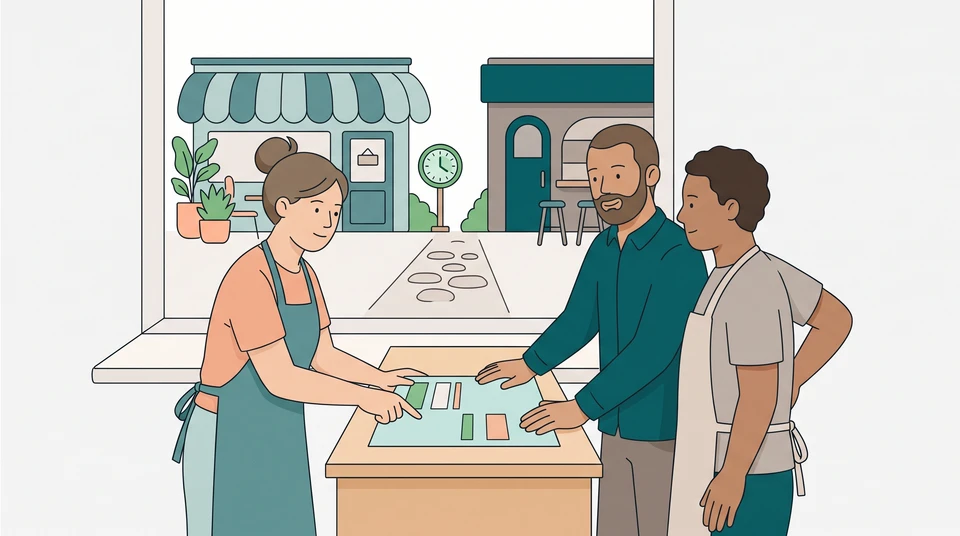
Before either manager confirms a shift, put both venues’ commitments in one place and leave time to get between them. A 2 p.m. finish at one café cannot also be a 2 p.m. start at a bar across town.
The useful question is not just “Is Sam available?” It is “When can Sam leave the first venue, reach the second and be ready to work—and who can confirm that plan?”
Establish one confirmed commitment record
Choose one record that both managers check before offering coverage: a shared sheet, a scheduling system or a paper plan kept by one coordinator. If you use separate venue schedules, name the person who reconciles them. Don’t leave the employee to settle competing promises.
For each cross-venue assignment, record:
- The employee, date, venue and role.
- The first shift’s start and realistic finish, including closing tasks or handover.
- The journey and any separate break or preparation time needed.
- The next shift’s proposed start and finish.
- Whether each commitment is proposed or confirmed, and who owns the decision.
Keep this record focused on coverage. Managers need availability and role readiness, not private reasons for a person’s time off. Before borrowing a new starter, check that the receiving manager knows which onboarding and training steps are complete and what support is still needed.
A café-to-bar example
Suppose Sam is scheduled at Harbour Café from 10 a.m. to 2 p.m. on Friday. The manager at nearby Lantern Bar requests Sam for a 2 p.m. start. In this example, both venues have the same employer and Sam is trained for both roles.
The café manager confirms Sam can finish all assigned work and leave at 2 p.m. Sam checks the route they will actually use: allow 25 minutes for the journey and another 10 minutes to arrive and get ready. That makes 2:35 p.m. the earliest workable start on these assumptions, not 2 p.m. Any required break needs its own allowance too.
The owner, Maya, is the named coordinator. She asks the bar manager whether someone else can cover until 3 p.m. If that cover is available and the remaining checks are satisfied, Maya can propose a 3 p.m. start to Sam. Until the arrangement is confirmed, the bar’s opening coverage stays marked as a gap—not as Sam’s shift.
These are example timings, not a travel estimate or a recommended break length. Use the real route, transport and working arrangements for your venues.
Account for travel between venues
Ask the employee how they will travel and check the journey at the relevant time of day. Include getting out of the first venue, walking to transport or parking, and reaching the second venue ready for the role. Don’t build the plan around a best-case drive if the employee takes a bus.
Keep travel and breaks separate. For US work covered by the FLSA, the Department of Labor says travel between job sites during the workday counts as working time. Don’t assume a trip between your venues is an unpaid commute; have payroll check how the travel-time rules apply to the actual arrangement.
Give payroll the full day’s plan and hours at both venues, including required travel. If the venues use different employing businesses, ask payroll or an employment adviser to check the arrangement rather than deciding from the venue names alone.
Resolve competing requests
Name one owner or manager who can settle clashes across both venues. Agree a practical rule: a new request stays proposed until that person checks existing commitments, speaks with both managers and confirms the employee’s availability.
In Sam’s example, the bar manager cannot solve the gap by simply moving Sam’s start to 2 p.m. The coordinator has three choices to investigate:
- Keep Sam’s café shift and arrange different bar coverage.
- Find suitable café cover so Sam can leave earlier, then recheck the journey and the changed shift.
- Delay Sam’s bar start and cover the opening another way.
Check the whole plan before choosing. Moving a person out of the café only helps if someone suitable can do the work left behind. If you manage both venues yourself, you can own this decision—there is no need to invent another approval layer.
For Australian teams, check the applicable award or agreement before changing the roster. The Fair Work Ombudsman explains that changes to regular rosters or ordinary hours require discussion with affected employees, and that awards and agreements can add roster rules. An internal coordinator’s decision does not replace those steps.
Recheck changes before confirming
Before sending the final plan, the coordinator checks both venues’ current schedules, the employee’s availability, role readiness, travel, breaks and hours. If lunch service runs late, reopen the receiving venue’s coverage plan instead of expecting Sam to absorb the delay.
Send one clear update with the date, both locations, shift times and the manager to contact if the plan changes. For example:
Sam, Friday’s proposed plan is Harbour Café, 10 a.m.–2 p.m., then Lantern Bar, 3–7 p.m. Maya is coordinating both venues. Please confirm whether you’re available for this arrangement. Maya will confirm the final plan once both managers have checked coverage.
After that confirmation, update both venue schedules and the shared commitment record. Ask each manager and Sam to acknowledge receipt of the final version. A reply saying “received” tells you the message arrived; it is not a substitute for confirming availability or following any required change process.
Start with a manual plan
Try CrewCentral’s free schedule maker to lay out a week manually, without an account or email. Its draft stays in your browser; it is not a shared cross-venue record. Keep the coordination record above where both managers can use it.
When you need a team workspace, explore CrewCentral scheduling. It connects scheduling with hiring, onboarding and training context. AI roster drafts are available with an account and need manager review. Keep the cross-venue travel and final coverage decision with a named manager.